Introduction
Close your eyes and picture the most romantic, cozy, memorable bedroom you have ever seen in a movie, a magazine, or on Pinterest. Chances are, it had an angled ceiling.
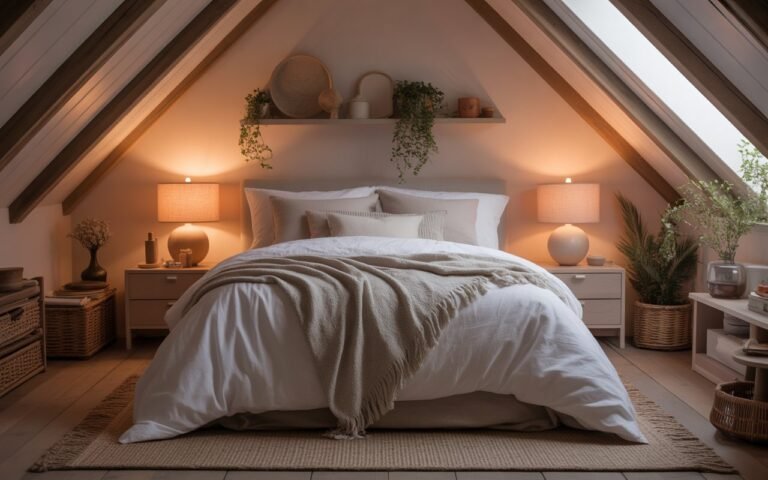
There is something undeniably special about a bedroom tucked under the eaves of a roof. The sloped walls wrap around you like a gentle embrace. The tucked-away feeling makes the room feel private, safe, and deeply personal. Skylights frame the night sky above your bed. Cozy nooks appear in every corner, begging for a book and a blanket.
And yet — so many homeowners stare at their attic bedroom and feel overwhelmed. Where does the furniture go? How do you hang anything on a sloped wall? Will it always feel cramped and dark?
Here is the truth that every interior designer knows: angled ceilings are not a design problem. They are a design opportunity that most people simply do not know how to use yet.
This guide changes that. We are going deep — deeper than any article you have read before — on exactly how to design a stunning, functional, and deeply cozy attic bedroom with angled ceilings. From furniture placement and color psychology to built-in storage, lighting tricks, reading nooks, kids’ rooms, and every texture and material worth considering, this is your complete reference.
Whether your attic is tiny or spacious, rough and unfinished or already plastered and painted, modern or rustic — by the end of this guide you will have a clear vision and the confidence to make it happen.
Let’s begin.
Why Attic Bedrooms with Angled Ceilings Are the Most Coveted Rooms in the Home
Before we talk about design, let us talk about desire. Because attic bedrooms with angled ceilings are not just architecturally interesting — they are emotionally resonant in a way that flat-ceilinged rooms rarely are.
Think about how children behave in these spaces. They immediately feel the magic. They call them “secret rooms” and “hideaways.” They curl up in the low corners with pillows and flashlights. They look up through the skylights at the stars.
That childhood instinct is not wrong. It is pointing at something real.
Psychologists who study the relationship between architecture and emotion use the term “prospect and refuge” to describe why humans feel so comfortable in spaces that offer both an open view and a protective enclosure. Attic bedrooms — with their high center peak opening up toward skylights, and their low angled sides wrapping close around you — deliver exactly this combination naturally.
In other words, your angled ceiling bedroom is already designed to make you feel good. Your job is simply to work with that architecture, not against it.
Here is what makes angled ceiling bedrooms so special from a design perspective:
Natural focal points. The peak of the roof creates an automatic focal point that draws the eye upward. You do not need to manufacture drama — the room already has it.
Built-in zones. The varying ceiling heights naturally divide the room into areas. High points feel grand and open — perfect for the bed. Low points feel intimate and cozy — perfect for seating, storage, and nooks.
Unique storage opportunities. The knee walls at the base of the angled ceiling create storage potential that flat-walled rooms simply do not have. Custom built-ins in these spaces are one of the smartest investments you can make in an attic bedroom.
Architectural character. Attic bedrooms do not need much decoration to feel interesting. The bones of the room — the angles, the beams, the eaves — already give it personality that most rooms spend years trying to achieve.
Now let us talk about how to make the most of all of it.
The Foundation — Furniture Layout and Placement
The Single Most Important Rule: Bed Goes Under the Peak
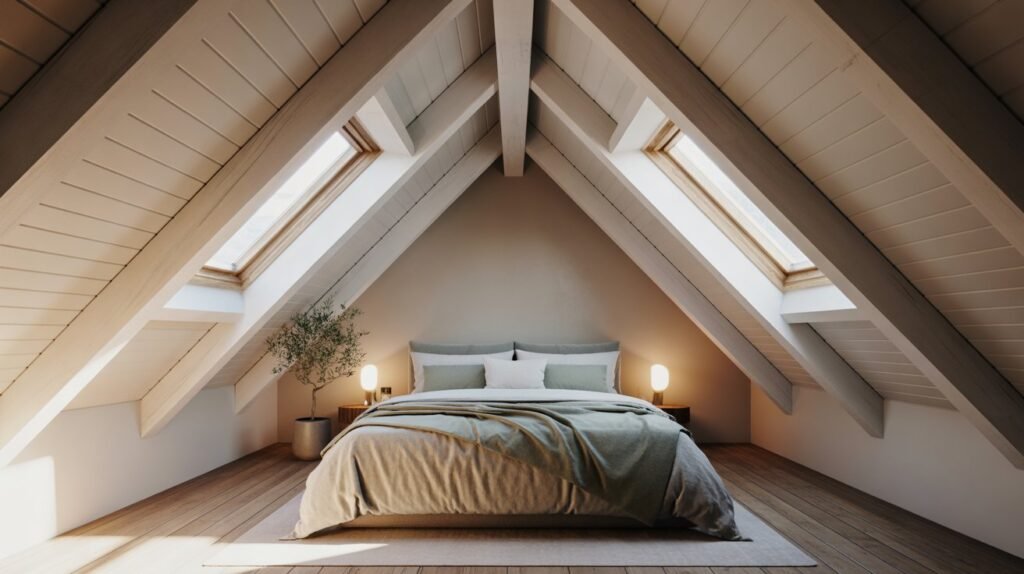
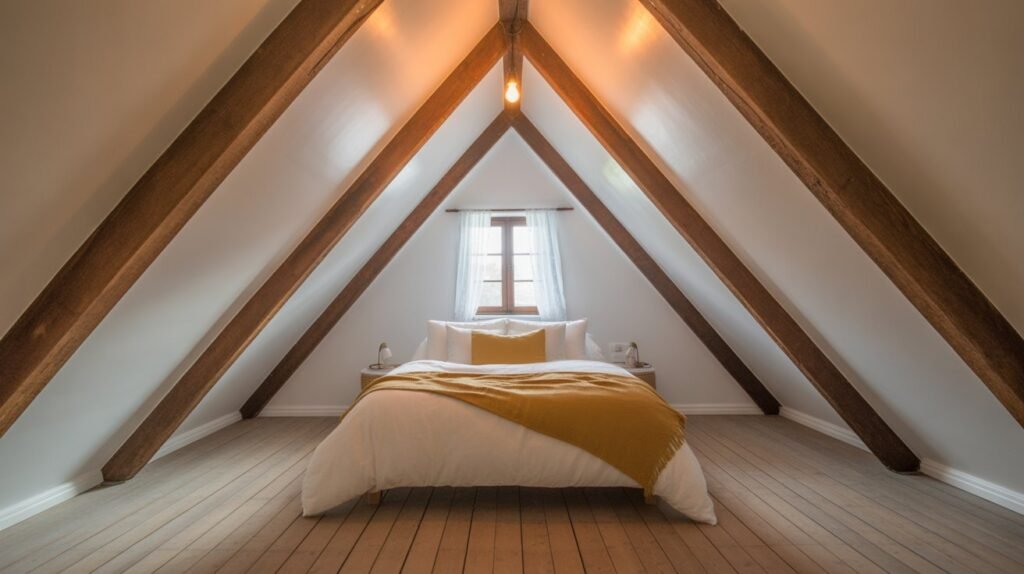
If you remember only one thing from this entire guide, let it be this: your bed belongs under the highest point of your angled ceiling.
This is not just an aesthetic preference. It is practical and psychological. When the bed sits under the peak of the roof, you have maximum headroom where you need it most — directly above where you sleep, sit up in the morning, and spend the most time in the room.
When the bed is placed anywhere else — pushed against a low knee wall, wedged into a corner — you get that uncomfortable feeling of the ceiling pressing down on you. Even if there is technically enough clearance, the visual weight of the slope above you feels oppressive.
Under the peak, the opposite happens. The ceiling rises above you, the room opens up, and the whole space breathes.
How to position the bed specifically:
If your attic has a central ridge running the length of the room, place the bed lengthwise beneath it, headboard against the flat end wall if one exists. This is the classic attic bedroom layout and it works beautifully almost every time.
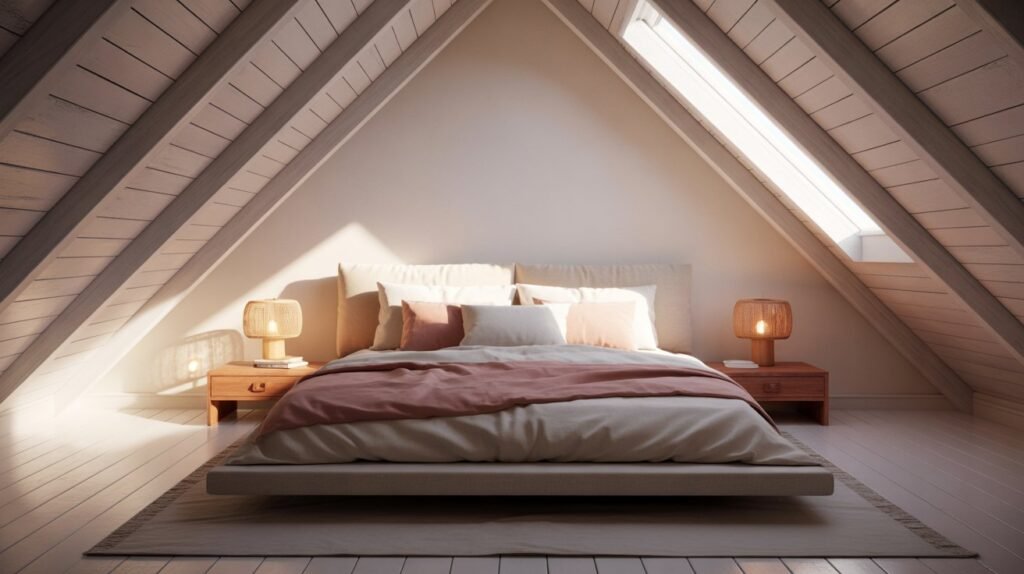
If both end walls are angled and there is no flat wall for a headboard, consider a bed with no headboard at all — or a very low upholstered headboard that sits comfortably beneath the slope. A floating shelf mounted to the wall at headboard height gives you a functional surface without requiring a freestanding headboard.
If the attic is wide and low with the peak running across rather than along the room, place the bed parallel to the ridge with the head of the bed at the highest point.
Bed styles that work best in attic bedrooms:
- Platform beds — low profile, modern, clean lines
- Japanese futon-style beds — extremely low, maximum clearance
- Upholstered beds without footboards — softer look, fewer hard lines
- Iron or brass bed frames — their open construction makes the room feel less cluttered
Bed styles to avoid:
- Tall four-poster beds — these fight with angled ceilings dramatically
- Beds with very high headboards — they eat into your precious clearance
- Bulky sleigh beds — their curved silhouette clashes with the geometry of the room
Furniture Placement Beyond the Bed
Once the bed is positioned, the rest of the furniture falls into place more naturally. Here is how to approach each piece:
Nightstands: Wall-mounted floating nightstands are ideal in attic bedrooms. They keep the floor clear, they can be installed at exactly the right height regardless of the slope, and they look clean and intentional. If you prefer freestanding nightstands, choose very low ones — at or below mattress height.
Dresser or chest of drawers: Place this on a flat end wall if one exists, or in a section of the room where the ceiling is high enough to accommodate it comfortably. A low, wide dresser is far better than a tall, narrow one in an attic room.
Seating: A small armchair or loveseat works beautifully in attic bedrooms when placed at the foot of the bed under the slope, or tucked into a dormer window alcove. Choose low, comfortable seating rather than high-backed chairs that bump against the ceiling.
Desk or workspace: If you need a desk in your attic bedroom, place it at a flat end wall or in a dormer alcove — these spots often have the best natural light for daytime work anyway.
What to avoid:
- Tall bookshelves pushed against sloped walls — they always look awkward and wasted
- Multiple large freestanding pieces competing for floor space
- Anything that forces you to crouch or duck when you use it
Storage Solutions That Actually Work
Let us talk about knee walls. These are the short, vertical walls that run along the base of your angled ceiling on both sides of the attic. In most unfinished or poorly designed attic rooms, the space behind these walls is simply dead — either inaccessible or used to shove boxes that never get touched.
With custom built-in cabinetry, this dead space becomes some of the most valuable storage in your home.
Because this storage sits low and deep — rather than tall and narrow — it is perfectly suited for:
Clothing storage: Deep drawers for folded clothes, pull-out rails for hanging items, shoe cubbies. A well-designed knee wall wardrobe on both sides of an attic bedroom can hold as much as a full walk-in closet.
Linen and bedding storage: Bulky duvets, spare pillows, and seasonal bedding are hard to store anywhere in most homes. Built-in knee wall cabinets with deep shelves solve this instantly.
Hidden toy storage (for children’s rooms): Deep bins or drawers behind cabinet doors keep a child’s room looking tidy in seconds.
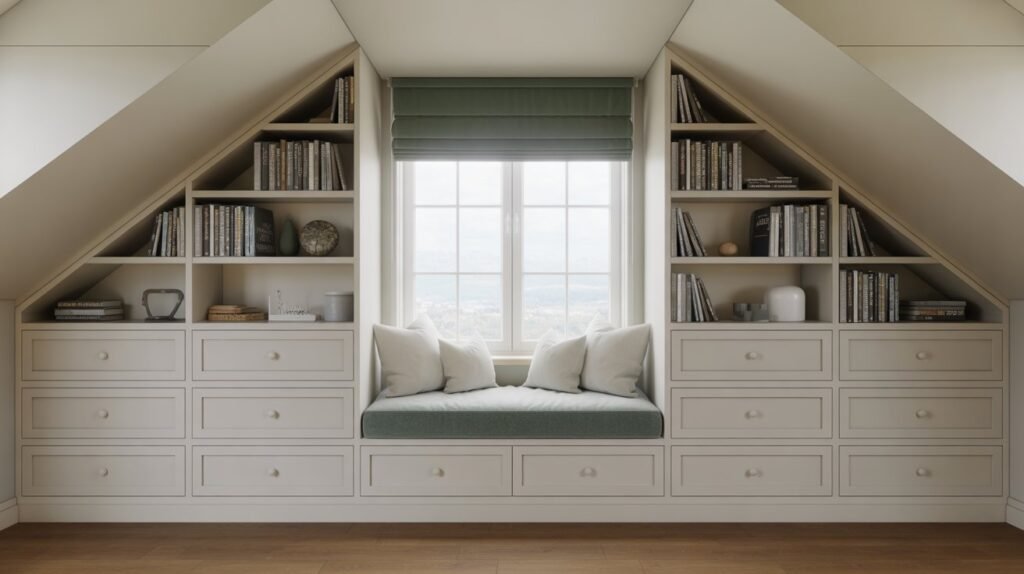
A window seat: Where the knee wall meets a dormer window, you can build a beautiful upholstered window seat with storage beneath — one of the most beloved design features in any attic room.
Books and media: Low, built-in bookshelves running the length of the knee wall create a library effect that is both functional and extraordinarily beautiful.
The key to making built-in knee wall storage look seamless is having it custom-built to exactly follow your ceiling angle. Off-the-shelf furniture never fits perfectly in these spaces. A local carpenter or a skilled cabinet maker will transform your knee walls into something that looks as though it was always part of the original house.
Finish options for built-in storage:
- Painted white or cream for a clean, Scandinavian look
- Painted to match the walls for a seamless, architectural feel
- Natural wood for a warm, rustic cabin aesthetic
- Navy or dark green for a bold, sophisticated statement
Under-Bed Storage
In an attic bedroom where floor space is precious, the space under your bed is prime real estate. A platform bed with built-in drawers gives you a significant amount of storage without taking any additional floor space. Choose a bed with two or three deep drawers on each side for maximum capacity.
Alternatively, bed risers can lift a standard bed frame high enough to slide large, flat storage boxes underneath — great for seasonal clothing, extra bedding, or luggage.
The Power of Vertical Space
At the highest point of your attic — directly under the ridge — you have more vertical space than anywhere else in the room. Do not waste it. Open shelving installed at ceiling height on the flat end walls gives you storage that doubles as decor. Style these high shelves with a mix of books, plants, baskets, and meaningful objects for a look that is both organized and beautiful.
Lighting — The Difference Between Dreamy and Dingy
Nothing transforms an attic bedroom more dramatically than getting the lighting right. And unfortunately, nothing makes an attic bedroom feel more disappointing than getting it wrong.
Natural Light First: Skylights and Dormer Windows
The first question to ask about lighting in any attic bedroom is: how much natural light are we working with?
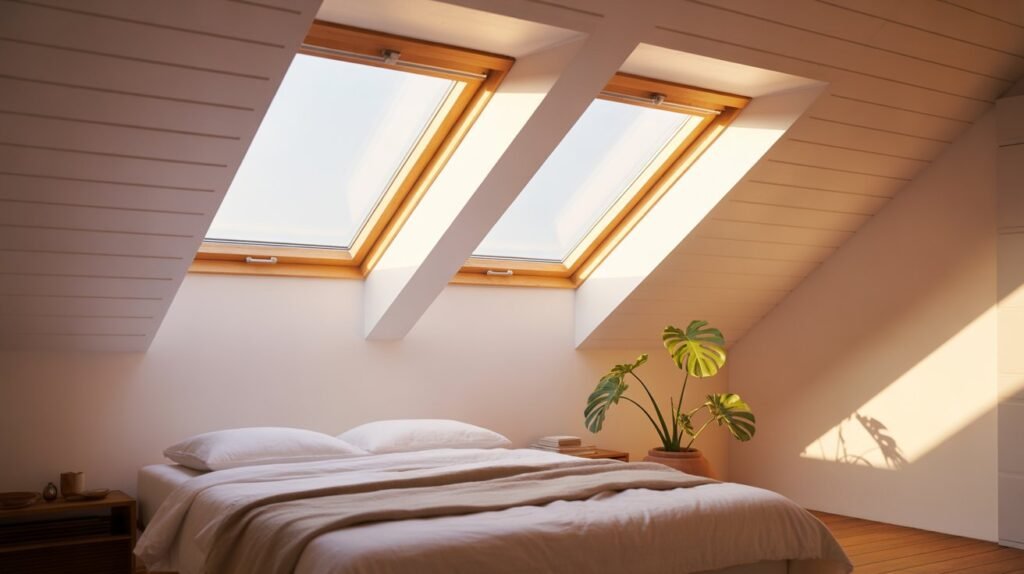
Skylights are the gold standard for attic bedrooms. Because they face the open sky rather than an adjacent wall, garden, or neighboring house, they bring in significantly more light per unit of area than a vertical window. A single well-placed skylight can transform a dark, cramped attic into a bright, airy retreat.
Types of skylights to consider:
Fixed skylights — the simplest and most affordable option, these do not open but flood the room with light. Perfect above the sleeping area.
Vented skylights — these open to allow airflow, which is particularly valuable in an attic room that can get warm in summer. Many modern vented skylights open automatically with rain sensors.
Tubular skylights — for attics where a full skylight is not structurally possible, tubular skylights use a reflective tube to pipe natural light from the roof surface down into the room. Surprisingly effective.
Dormer windows serve a different purpose from skylights. Rather than bringing light in from above, they punch a vertical window through the slope of the roof, creating a small alcove of usable wall space. This alcove is perfect for a desk, a window seat, or a dressing area. Dormers also allow for ventilation and give the room a view, which a skylight does not.
Artificial Lighting:
In any well-designed bedroom, lighting comes from multiple sources at different heights. In an attic bedroom, this principle is even more important because the uneven ceiling height means a single overhead light creates deeply unflattering shadows in the low corners.
The solution is to think in three layers:
Layer 1 — Ambient lighting: This is your general room illumination. In an attic bedroom, recessed spotlights installed along the ridge or at intervals along the sloped ceiling work beautifully. They follow the angle of the ceiling naturally and can be angled to wash light across the walls. Dimmable options are essential — you want full brightness for getting dressed in the morning and warm, low light for reading at night.
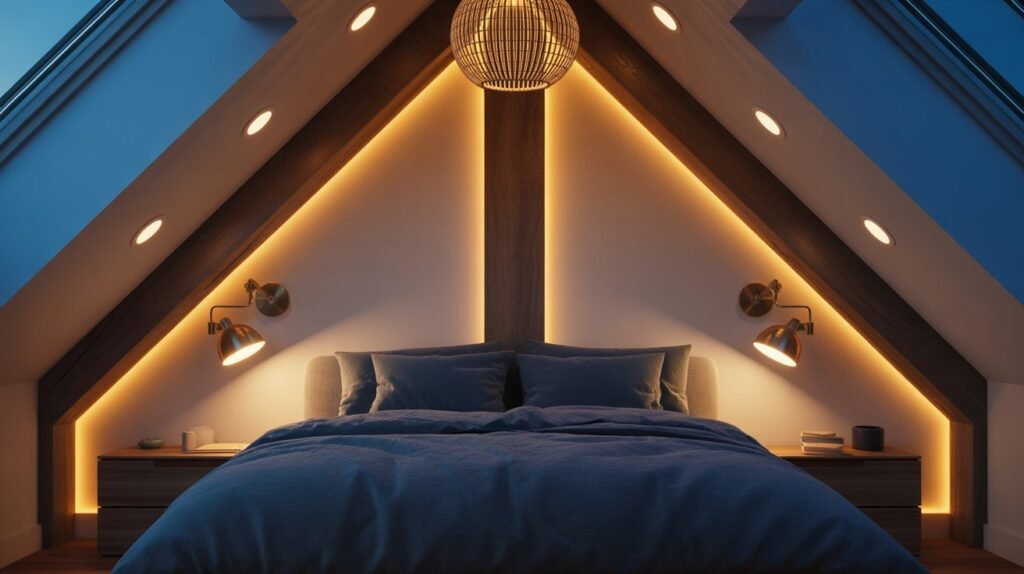
Layer 2 — Task lighting: Bedside reading lights, a desk lamp if you have a workspace, and lighting inside wardrobe areas fall into this category. Wall-mounted swing-arm sconces at each side of the bed are ideal — they free up nightstand surface space and put light exactly where you need it for reading.
Layer 3 — Accent lighting: This is what transforms a good bedroom into a magical one. Consider LED strip lights running along the inside of the ridge beam to create a soft warm glow along the ceiling peak. Fairy lights draped along exposed beams. A statement pendant light hanging from the highest point of the ceiling — a rattan globe, an oversized paper lantern, or a sculptural metal fixture.
Lighting placement tips specific to angled ceilings:
- Never install a single central overhead fixture — it creates an uneven, unflattering pool of light
- Use warm white bulbs (2700K-3000K) throughout for a cozy, inviting atmosphere
- Avoid cool white or daylight bulbs (5000K+) — they make attic rooms feel clinical and harsh
- Install dimmers on every circuit — the ability to control mood with light intensity is invaluable in a bedroom
Color — How to Paint an Attic Bedroom with Angled Ceilings
Color choice in an attic bedroom is not just about personal taste. The colors you choose on the angled surfaces have a direct, measurable impact on how large, bright, and comfortable the room feels.
Strategy 1: The All-Over Approach (Most Popular)
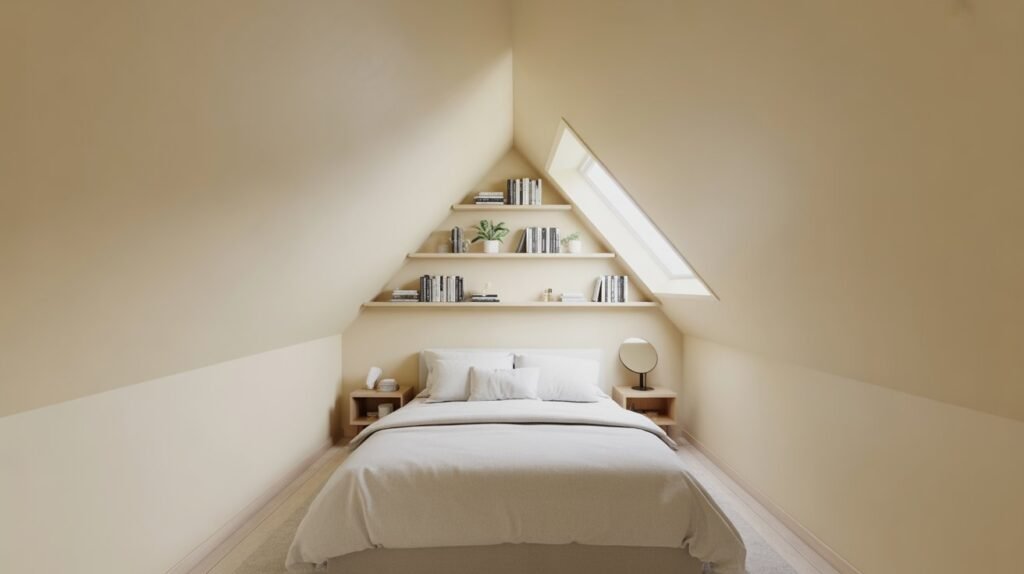
Paint the walls, angled ceiling, knee walls, and any built-ins all in the same soft, light color. Warm white, soft cream, or pale greige work best.
This approach is powerful because it removes the visual contrast between the different surfaces. When everything is the same color, the eye cannot easily detect where the wall ends and the ceiling begins. The angles become less visually aggressive, and the whole room feels more spacious and cohesive.
This is the approach most commonly seen in Scandinavian and Japandi-style attic rooms — and it is enduringly popular for very good reason. It always works.
Best colors for the all-over approach:
- Warm white (Farrow & Ball “All White,” Sherwin-Williams “Alabaster”)
- Soft cream (Farrow & Ball “Steps,” Benjamin Moore “White Dove”)
- Warm greige (Farrow & Ball “Elephant’s Breath,” Sherwin-Williams “Accessible Beige”)
Strategy 2: Contrast Ceiling for Drama
For those who want their attic bedroom to feel bold and intentional, painting the angled ceiling a significantly darker shade than the walls creates a striking cocoon effect.
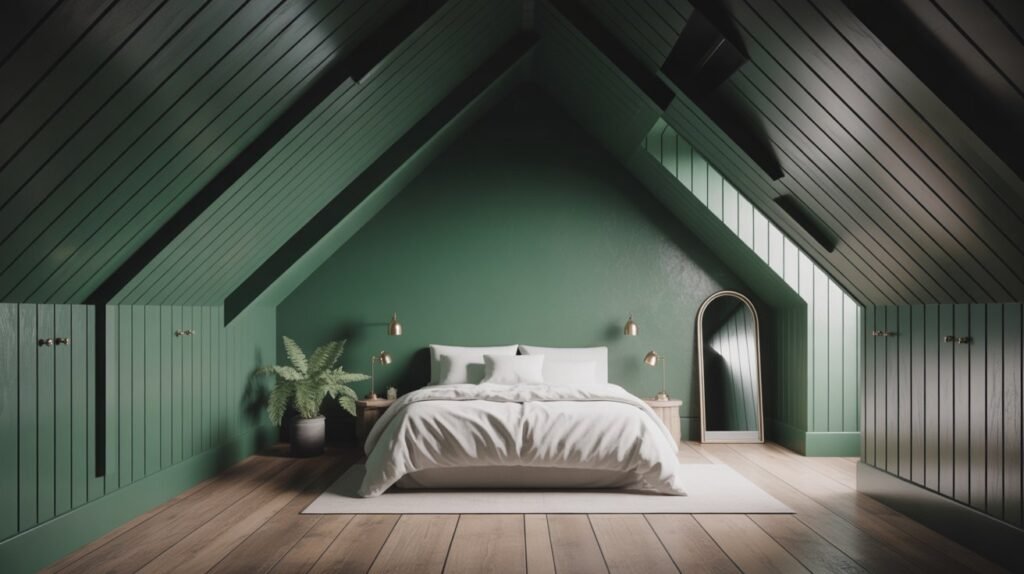
Deep navy, forest green, charcoal, rich terracotta, or dusty plum on the ceiling, paired with crisp white walls below, transforms the slopes into a dramatic architectural statement. The low angled surfaces wrap around you in a rich color while the walls keep the room feeling open and airy.
This approach works best in attic bedrooms with good natural light — either from skylights or dormer windows — because the dark ceiling can make a naturally dark room feel gloomy.
Strategy 3: Wood Everywhere
If your attic has exposed structural beams, tongue-and-groove cladding, or shiplap panels, consider leaving them in their natural wood finish rather than painting them. Natural wood on the angled ceiling and walls, combined with white or cream on the flat end walls, creates a warm, cabin-like atmosphere that is timeless and endlessly cozy.
This approach pairs beautifully with linen bedding, woven baskets, potted plants, and other natural textures.
Strategy 4: Wallpaper on the Flat End Walls
If your attic has flat end walls — vertical walls at the two ends of the room — these are the ideal place to introduce pattern through wallpaper. A beautiful botanical print, a subtle geometric, a classic stripe, or a textured grasscloth on these flat walls adds personality without the complication of papering over the slopes.
Keep the angled ceiling and knee walls plain (painted white) to let the wallpapered end walls shine.
The Cozy Nook — Turning Awkward Corners into the Best Spot in the House
Here is one of the greatest gifts an angled ceiling gives you: the reading nook.
The lowest corners of your attic — where you cannot comfortably stand, where furniture always feels awkward — are absolutely perfect for a cozy, tucked-away reading nook. This is one of those design moves where the apparent limitation becomes the most beloved feature of the room.
How to Build the Perfect Attic Reading Nook
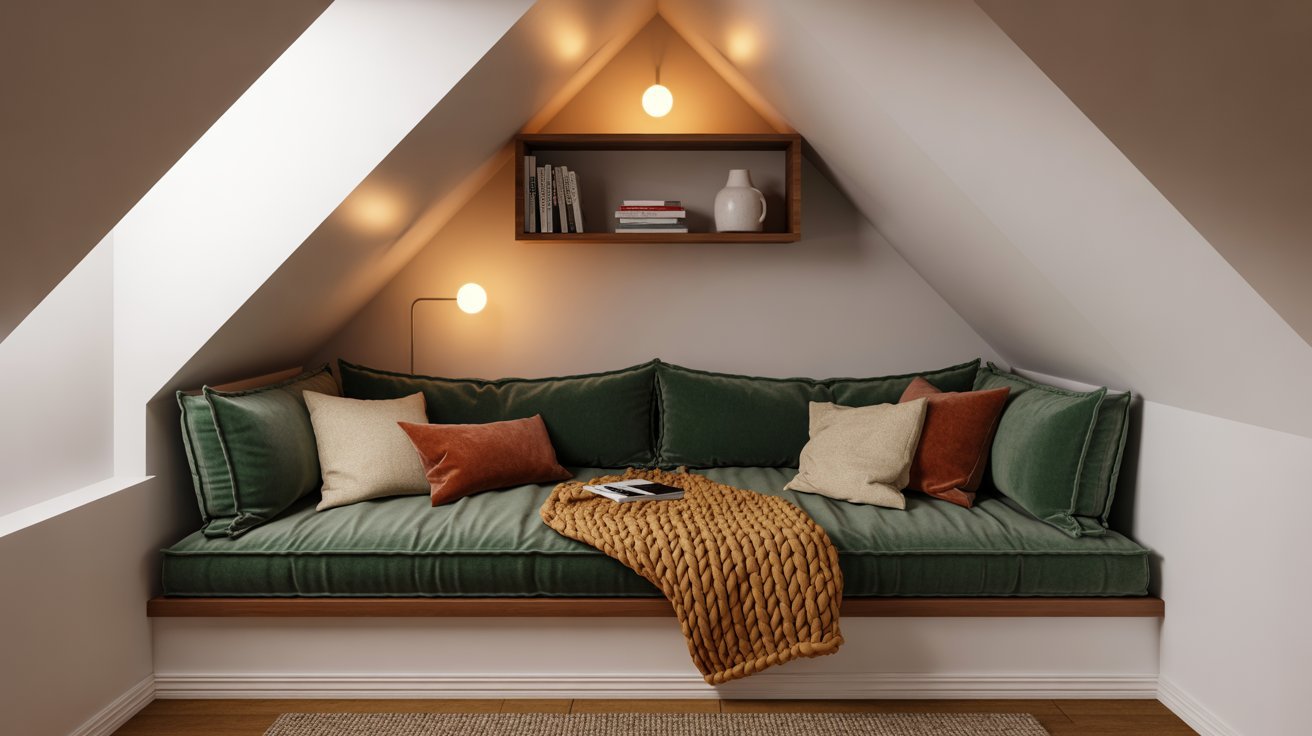
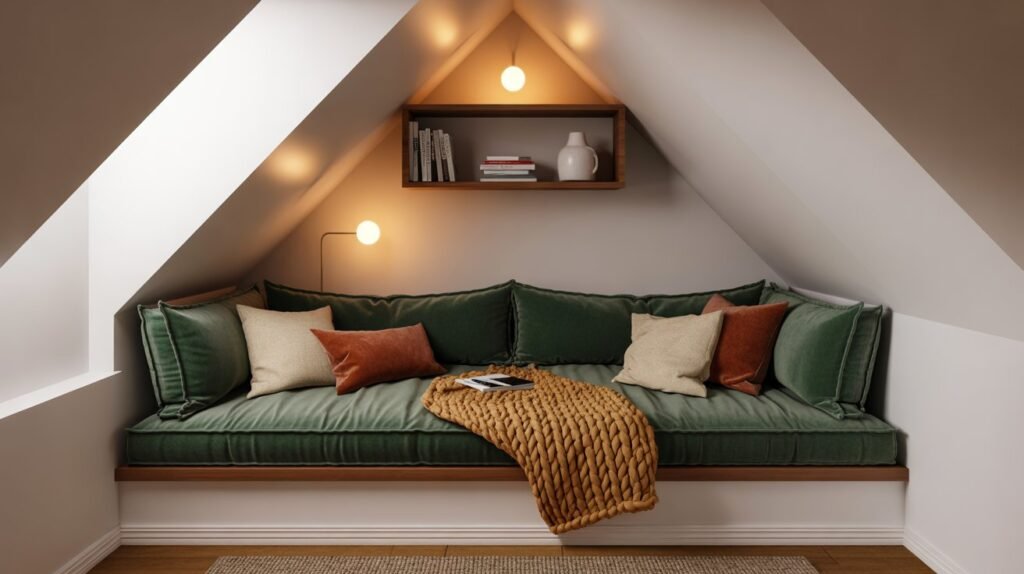
Start with seating. A built-in window seat is the ultimate reading nook foundation. Have a carpenter build a low bench with a hinged lid (for storage inside) beneath a dormer window. Top it with a 4-inch thick foam cushion covered in a durable, washable fabric — linen, cotton velvet, or bouclé all work beautifully.
If building in is not possible, a deep armchair or a daybed wedged into the corner under the slope achieves the same cozy effect.
Add light. A reading nook without good light is just a dark corner. A wall-mounted adjustable reading light, a small plug-in sconce, or a hanging pendant above the seat gives you warm, focused light for evening reading. A nearby dormer window handles daytime light naturally.
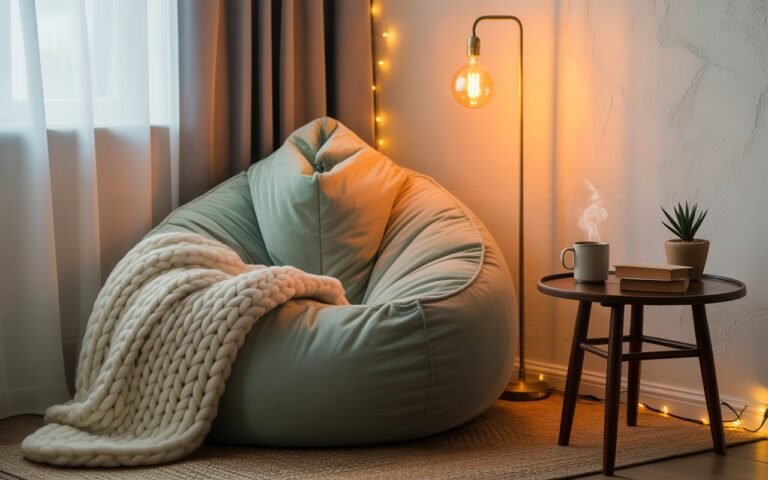
Layer the textiles. This is where the nook goes from functional to irresistible. A thick cushion, three or four throw pillows in complementary textures and patterns, a chunky knit blanket draped over the arm — these layers of softness make the nook feel like a private world you never want to leave.
Add a small shelf. A narrow floating shelf above or beside the nook for books, a candle, and a small plant completes the picture. Everything you need, within arm’s reach.
The floor. A small, round rug under the nook area anchors it visually and adds warmth underfoot when you curl up barefoot.
Texture and Materials — Giving Your Attic Bedroom Soul
An attic bedroom without texture is just a room with an unusual ceiling. Texture is what gives a space warmth, depth, and the feeling that it has been thoughtfully curated rather than quickly furnished.
Wood — The Attic’s Best Friend
Wood is the single most powerful material you can use in an attic bedroom. Whether it appears as exposed structural beams, shiplap wall cladding, a tongue-and-groove ceiling, or simply warm wood flooring, it immediately makes the space feel intentional and alive.
Exposed beams: If your attic has structural timber beams, expose them. Strip off any drywall or plaster covering them, sand them smooth, and either leave them in their natural color, stain them a deeper walnut or ebony, or paint them white for a Coastal Grandmother aesthetic.
Shiplap and tongue-and-groove paneling: These classic wood paneling styles installed on the angled ceiling add warmth and texture without overwhelming the space. Painted white, they add subtle texture while keeping the room bright. Left in natural wood, they create a full cabin aesthetic.
Wood flooring: In an attic bedroom, the warmth of wood or wood-effect flooring is almost always preferable to the coldness of tile. Wide-plank oak, whitewashed pine, or a warm walnut laminate all work beautifully.
Textiles — Softness Against the Angles
The hard geometry of angled ceilings calls for generous softness in the textiles. Layered bedding — a fitted sheet, a flat sheet, a light quilt, and a heavier duvet — feels luxurious and also visually softens the room.
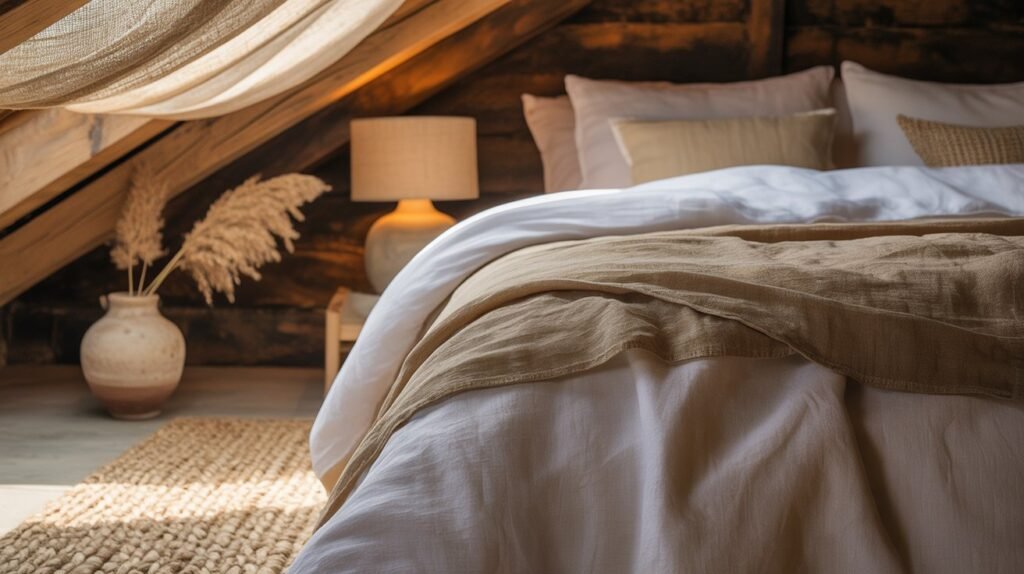
Bedding: Linen is the material of choice for attic bedrooms in almost every aesthetic. It has a casual, lived-in beauty that pairs perfectly with sloped ceiling architecture. Linen in ivory, sage, dusty pink, or deep navy all look stunning.
Rugs: A large rug under the bed, extending at least 60cm on both sides, grounds the room and makes the sleeping area feel intentional. Natural fiber rugs — jute, sisal, seagrass — add texture and warmth. For softness underfoot, a wool rug is incomparably luxurious.
Curtains: Hang curtains higher and wider than the window for maximum drama and the illusion of height. Floor-length curtains in linen or cotton voile flutter beautifully near dormer windows and add a softness that bare windows cannot.
Attic Bedroom Ideas for Every Style
White walls, white ceiling, light oak floors, natural linen bedding, a single pendant light, a potted plant, and clean-lined furniture. Nothing extra, nothing wasted. This style makes attic bedrooms feel serene, spacious, and deeply calming.
Key elements: All-white palette, natural wood, linen textiles, simple lighting, minimal decor, plants
Cottagecore Attic Bedroom
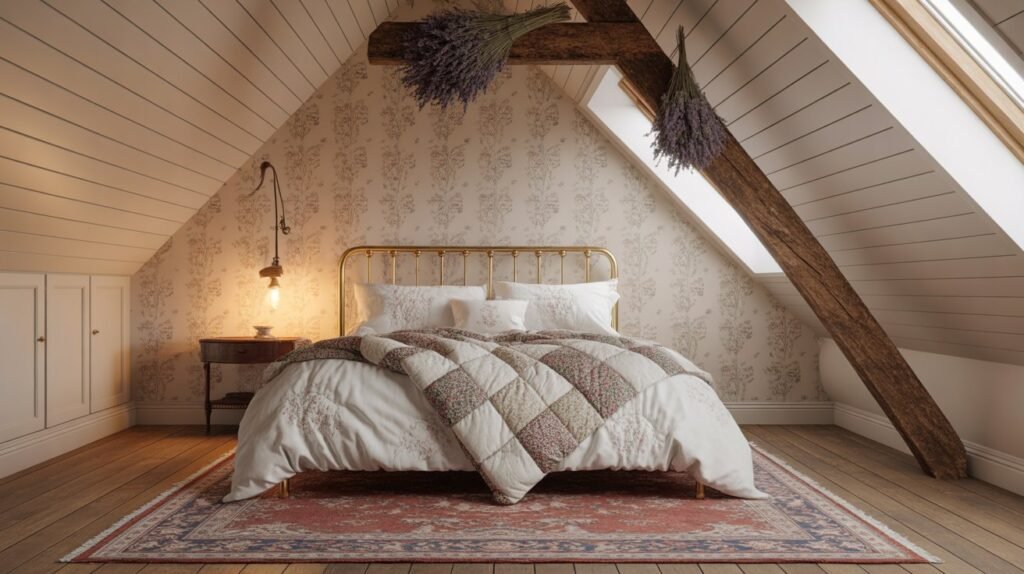
Shiplap walls, exposed beams, floral wallpaper on the end wall, a patchwork quilt, antique brass fixtures, a worn Persian rug, dried flower arrangements. This style leans into the romantic, old-world character of attic rooms completely.
Key elements: Pattern mixing, botanical motifs, vintage finds, warm colors, natural materials
Modern Boho Attic Bedroom
Terracotta walls, rattan furniture, macramé wall hanging, layered rugs, hanging plants from the ridge beam, a low bed with printed throw pillows, warm Edison bulb lighting. This style feels globally inspired and effortlessly relaxed.
Key elements: Warm earthy tones, natural textures, global patterns, plants, eclectic layering
Industrial Attic Bedroom
Exposed brick end wall, metal bed frame, concrete floor, black steel-framed windows in the dormer, Edison bulbs on black pendant cords, raw wood shelving. This style turns the utilitarian bones of the attic into a design feature.
Key elements: Raw materials, dark metal, exposed surfaces, minimal soft furnishings
Kids’ Magical Attic Bedroom
Glow-in-the-dark stars on the angled ceiling, a loft bed at the peak with a ladder, built-in bunk beds in the knee walls, a chalkboard wall, rope lights along the beams, a reading tent in the corner. For children, the attic bedroom is already a fairy tale — your job is simply not to get in the way of the magic.
Key elements: Built-in bunks, fun lighting, interactive surfaces, abundant storage, room to play
Common Mistakes to Avoid in Attic Bedroom Design
Even with the best intentions, certain mistakes appear again and again in attic bedroom design. Here is how to avoid them.
Mistake 1 — Fighting the angles instead of embracing them. The biggest mistake is treating the angled ceiling as something to hide or minimize. Bold design choices that celebrate the slopes — dark paint on the ceiling, exposed beams, built-ins that follow the angle — always look better than attempts to disguise them.
Mistake 2 — Choosing furniture that is too tall. A six-foot-tall bookshelf shoved against a slope that is four feet high at that point creates an awkward, wasted gap and looks like a mistake. Always measure your ceiling height at the exact spot where a tall piece of furniture will stand before purchasing it.
Mistake 3 — Neglecting the knee wall space. Leaving the space behind the knee walls empty or accessible only through a small hatch is a missed opportunity. Building storage into these spaces — even inexpensively with simple shelving — dramatically improves the function of the room.
Mistake 4 — Single-source lighting. A lone ceiling fixture in an attic bedroom leaves the low corners in shadow and the center in a harsh pool of light. Always layer your lighting — ambient, task, and accent sources working together.
Mistake 5 — Ignoring ventilation and temperature. Attic rooms can become very hot in summer and cold in winter due to their proximity to the roof. Ensure adequate insulation, install a vented skylight or ceiling fan if possible, and consider an electric baseboard heater for winter months.
Mistake 6 — Overcrowding the space. It is tempting to furnish an attic bedroom the way you would a regular bedroom — nightstands, dresser, desk, armchair, wardrobe. But attic rooms reward restraint. Choose fewer, better pieces. Leave breathing room. The architecture does enough.
Small Attic Bedroom Ideas — Maximum Impact, Minimum Space
Not every attic is generous with its square footage. If you are working with a compact attic bedroom, these specific strategies will help you maximize every inch.
Go monochromatic. A single color — wall, ceiling, built-ins, and bedding all in the same soft hue — makes a small attic feel significantly larger. Any contrast between surfaces emphasizes the boundaries of the room. Removing that contrast makes the boundaries dissolve.
Use a murphy bed. A wall-mounted murphy bed (fold-down bed) that tucks away during the day transforms an attic bedroom into a fully usable daytime space. When folded down, it looks like a standard bed. When folded up, the room becomes a study, a home office, or a yoga space.
Maximize the vertical. Build shelving all the way up to the ridge point. Use hanging storage — canvas bags, baskets on hooks, hanging organizers — to keep things off the floor without taking up wall space.
Choose glass and lucite. Transparent or semi-transparent furniture — a ghost chair, a glass-topped desk, a lucite stool — takes up visual space without taking up actual space. In a small attic room, this can feel like magic.
Limit your palette to three materials. In a small space, material discipline is essential. Choose one wood, one textile color, and one metal finish — and use only those throughout the room. Consistency creates calm; variety creates chaos in tight spaces.
Conclusion
The attic bedroom with angled ceilings is one of the most rewarding spaces in residential design. It asks something of you — a little more thought, a little more creativity, a little more willingness to work with an unusual architecture rather than imposing a standard solution onto it.
But when you give it that thought and creativity, it gives you something back that flat-ceilinged bedrooms simply cannot: a room with real soul.
A room that feels like it was made specifically for you.
A room where the morning light through the skylight falls exactly right. Where the reading nook under the slope is the most fought-over spot in the house. Where the built-in storage makes every morning easier. Where the exposed beams give the ceiling weight and warmth and character.
Start with the bed position. Build into the knee walls. Bring in as much light as you can. Choose colors that work with the angles rather than against them. Layer your textiles and your lighting. And above all, stop apologizing for the slopes and start celebrating them.
The most beautiful attic bedrooms on Pinterest — the ones that stop your scroll and make your heart ache a little — are not beautiful despite their angled ceilings. They are beautiful because of them.