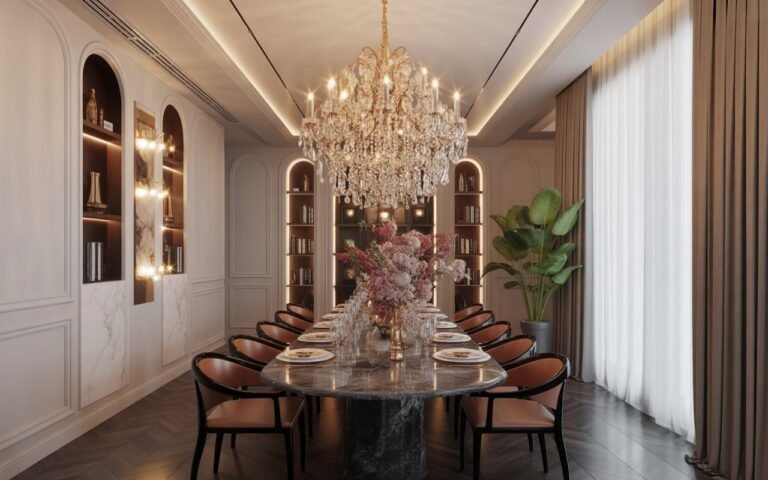
Here is the single most common dining room mistake people make — and almost nobody talks about it. It is not the wrong paint color. It is not mismatched chairs. It is either having no rug at all or buying one that is far too small for the space.
A dining room without a rug feels cold, unfinished, and acoustically harsh. A dining room with the wrong size rug looks even worse than no rug at all — like an afterthought rather than a design decision. But get the rug right, and something remarkable happens. The entire room clicks into place. The table feels anchored. The space feels intentional. The room feels like it was designed rather than just furnished.
This guide covers everything you need to know about dining room rug ideas — from choosing the right size and material to finding the perfect style for your space, your family, and your budget. By the end, you will know exactly what to buy and why.
Why Every Dining Room Needs a Rug
A rug does far more than add color and pattern to a dining room floor. It is one of the hardest working design elements in the entire space.
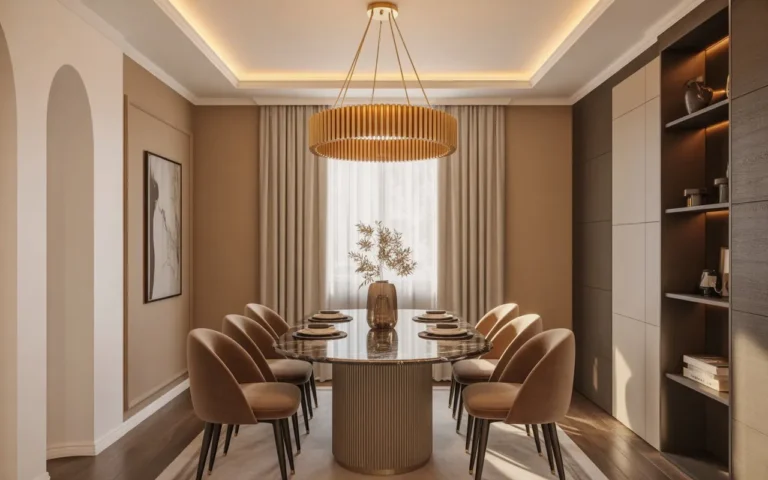
Visually, a rug grounds the dining table and chairs into a cohesive unit. Without it, even the most beautiful dining table can feel like it is floating aimlessly in the room. With it, everything reads as one intentional arrangement.
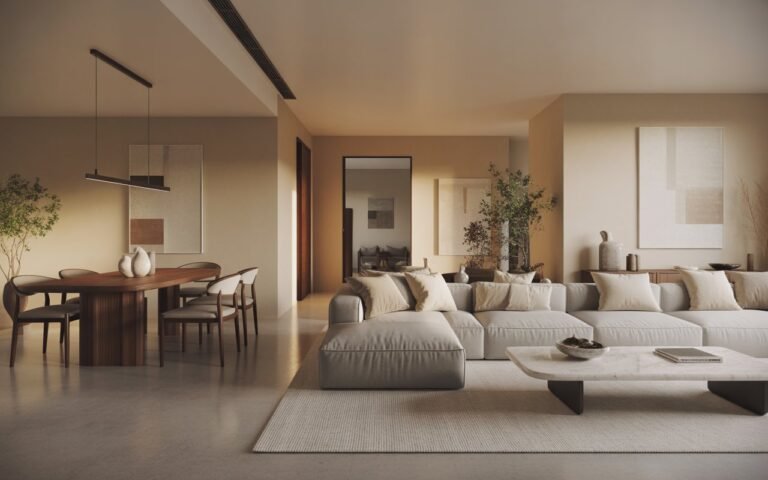
In open concept homes — where the dining area flows directly into the kitchen or living room — a rug is the most effective tool for defining the dining zone without walls or physical barriers. It tells the eye where one space ends and another begins.
Practically, a rug protects hardwood floors from the daily abuse of chair legs dragging back and forth. Anyone who has seen scratched hardwood under a dining table knows exactly how costly that damage can be. A rug eliminates that problem entirely.
It also absorbs sound. Hard floors in a dining room create an echo chamber effect — voices bounce, cutlery clangs, chairs scrape. A rug softens all of that, making conversation more comfortable and the room more pleasant to be in.
And for renters? A beautiful rug transforms a rental dining area with zero permanent changes. It is the highest-impact, fully reversible decorating move available.
The Dining Room Rug Size Guide
This is the section most people need most — and most rug retailers make confusing. Let us make it simple.
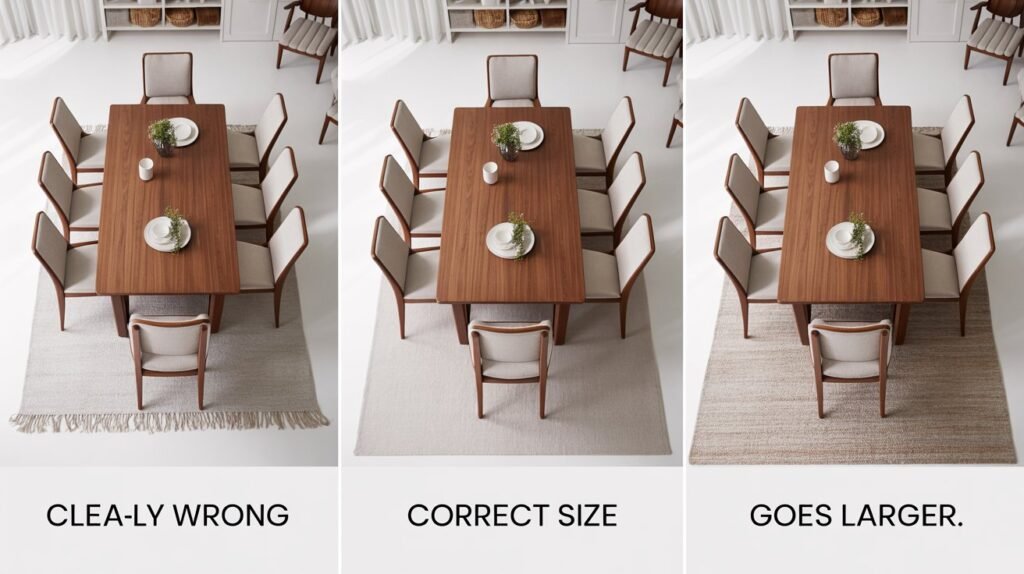
The golden rule of dining room rugs is this: all chair legs must remain on the rug even when the chairs are pulled out from the table.
This is non-negotiable. When someone pulls their chair back to sit down or stand up, the back legs of that chair move backward. If those back legs slide off the rug onto the hard floor, the chair catches and tips. It feels wrong, looks wrong, and ruins the entire effect of the rug.
To calculate the minimum rug size you need, take your dining table dimensions and add 24 inches to each side. That 24 inches accounts for the chair depth plus the pulling-out space.
For practical guidance:
A 4-seater dining table (typically 36 by 48 inches) needs a minimum rug size of 8 by 10 feet. This is the most common dining room rug size sold and fits the majority of standard dining rooms.
A 6-seater dining table (typically 36 by 72 inches) needs a minimum rug size of 9 by 12 feet. Do not be tempted to go smaller — an 8 by 10 foot rug under a 6-seater table will always look too small.
An 8-seater dining table (typically 40 by 96 inches) needs a minimum rug size of 10 by 14 feet. At this scale, a custom or vintage rug is often the best solution.
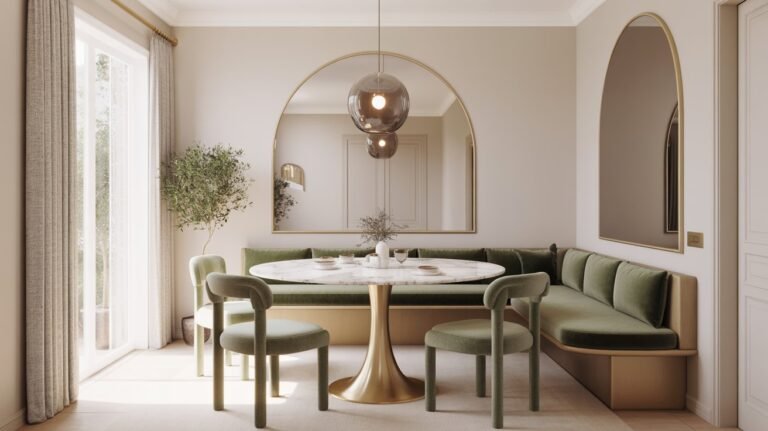
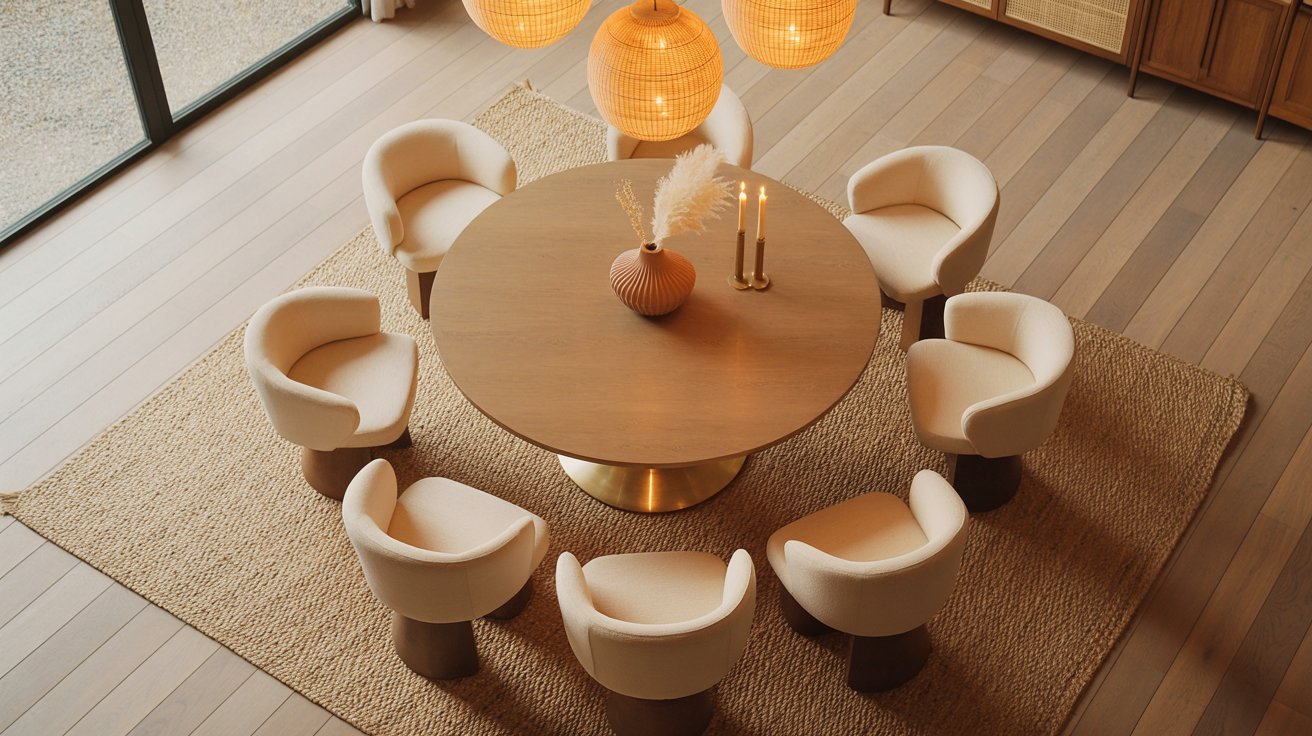
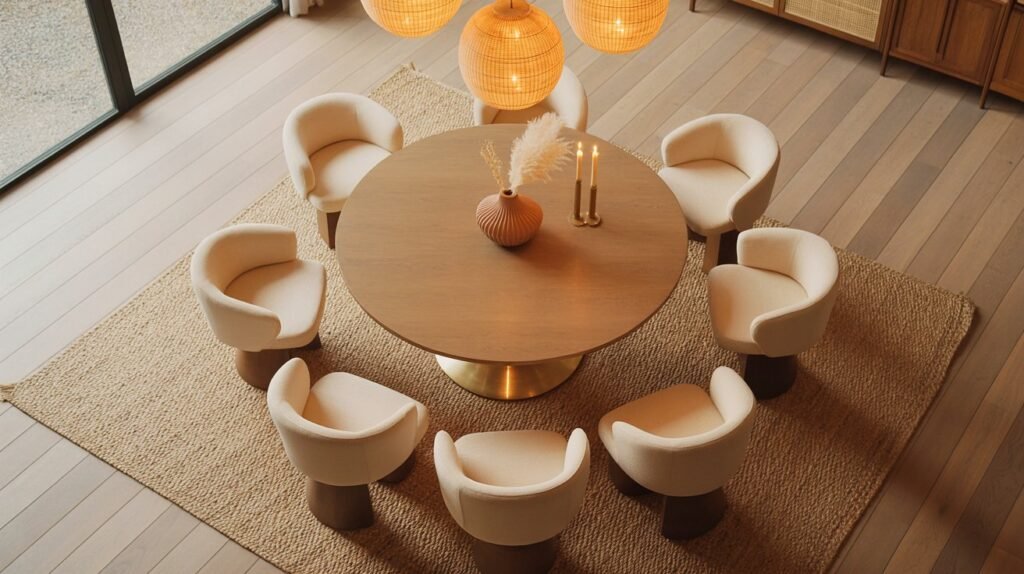
A round dining table (48 to 54 inches diameter) pairs beautifully with a round rug at least 8 feet in diameter, or a square rug at 8 by 8 feet minimum.
When in doubt, go larger. A rug that is too large reads as intentional and generous. A rug that is too small reads as a mistake every single time.
Best Rug Materials for Dining Rooms
Material is the most practical decision you will make about your dining room rug — because dining rooms are messy. Food drops. Drinks spill. Chairs drag. Your rug needs to handle all of it.
Jute and Sisal are the most popular natural fiber options for dining room rugs, and for good reason. They are beautiful, affordable, and add incredible organic texture that works with almost every design style. The honest downside is that natural fibers absorb liquid rather than repelling it, making spills harder to clean. Jute works best in dining rooms where spills are infrequent and the aesthetic payoff outweighs the maintenance trade-off.
Wool is the premium choice for dining room rugs. It is naturally stain resistant, extraordinarily durable, and gets softer and more beautiful with age. A high-quality wool rug in a dining room is an investment that pays off over fifteen to twenty years of daily use. If you have the budget, wool is always worth it.
Polypropylene and synthetic rugs are the most practical choice for families with young children or heavy daily use. They are completely stain resistant, fade resistant, easy to clean with soap and water, and available at every price point. The best synthetic rugs today are virtually indistinguishable from natural fiber rugs in photographs — the texture and visual warmth have improved dramatically.
Washable rugs deserve their own category because they have genuinely changed the game for dining rooms. Brands like Ruggable have made machine-washable rugs in beautiful, design-forward styles that work perfectly in dining rooms. For families with young children, pets, or anyone who wants zero anxiety about spills, a washable rug is the single smartest choice.
Viscose and silk-look rugs are beautiful but absolutely not recommended for dining rooms. They flatten under furniture weight, stain permanently with water, and deteriorate quickly under heavy use. Save the silk-look rug for a low-traffic bedroom.
Dining Room Rug Style Ideas
Natural and Organic Rugs — jute, seagrass, chunky woven wool, and sisal — are the most universally pinned dining room rug style on Pinterest right now. They work with organic modern, Scandinavian, coastal, and farmhouse dining rooms equally well. Their neutral texture adds warmth without competing with furniture or wall color.
Modern Minimalist Rugs keep things simple and intentional. A solid color low-pile wool rug in warm white, warm gray, or deep charcoal. A subtle tone-on-tone geometric. A clean bordered flatweave. These rugs disappear into the room in the best possible way — they anchor the space without drawing attention to themselves.
Boho and Eclectic Rugs are the most expressive option. Vintage Turkish kilims, Moroccan Beni Ourain rugs, faded Persian patterns, and hand-knotted abstract designs all bring history, color, and soul to a dining room. One well-chosen vintage rug under a simple dining table is a complete design statement on its own.
Modern Farmhouse Rugs lean into stripe patterns, faded vintage prints, braided textures, and natural fibers. A wide-stripe cotton flatweave in cream and black, or a faded botanical Persian print, works beautifully with shiplap walls, black metal light fixtures, and warm wood dining tables.
Bold Geometric and Pattern Rugs suit maximalist and contemporary dining rooms that embrace color and visual energy. A large-scale diamond pattern in jewel tones, a graphic black and white chevron, or an abstract brushstroke print makes the rug the centerpiece of the entire room.
Dining Room Rug Color Ideas
Color selection comes down to one principle: the rug should connect the dining room to itself — pulling from the wall color, the chair upholstery, or the curtain fabric — rather than existing as an isolated element.
Neutral rugs in cream, warm white, sand, and oatmeal are the safest and most versatile choice. They brighten the room, pair with any furniture color, and never look dated. The downside is that they show stains more readily — which is exactly why washable rugs in neutral tones have become so popular.
Dark rugs in navy, forest green, charcoal, and deep terracotta are a sophisticated choice that hides stains brilliantly. A deep navy rug under a warm walnut dining table with cream chairs is one of the most beautiful and practical combinations in dining room design.
Patterned rugs work in dining rooms when the pattern connects to at least one color already present in the room. If your dining chairs are a warm sage green, a rug with sage tones ties the whole room together. The pattern should never introduce a color that appears nowhere else in the space.
For floor-to-rug color matching: light floors pair best with medium to dark rugs or patterned rugs that add visual interest. Dark floors pair best with lighter, warmer rugs that create contrast and prevent the room from feeling heavy.
Dining Room Rug Ideas for Every Situation
Small dining rooms benefit enormously from a rug that fits perfectly — not one chair leg hanging off the edge. In small spaces, a round rug under a round table is the most elegant solution, creating one unified circular arrangement that makes the room feel intentional and curated rather than cramped.
Open concept dining rooms need a rug large enough to fully contain the dining table and all chairs with room to spare — because the rug is doing the work of defining the zone. Going too small in an open plan makes the dining area feel like it is swallowed by the larger space.
Families with kids and pets should go directly to washable rugs or high-quality polypropylene. The anxiety of watching red sauce head toward a cream jute rug is not worth any aesthetic payoff. Choose a pattern over a solid — patterns hide the inevitable.
Renters have the most to gain from a beautiful dining room rug. It covers ugly floors, defines the space, and moves with you when you go. A good rug is the highest-return rental upgrade available.
Common Dining Room Rug Mistakes to Avoid
Buying a rug that is too small is the most common and most damaging mistake. Measure twice. Buy once. Always go larger when between sizes.
Choosing a high-pile or shag rug for a dining room creates a practical nightmare — food traps in the pile, chairs catch on it, and cleaning becomes a daily battle. Keep dining room rugs low-pile or flatweave.
Skipping the rug pad is a mistake that causes the rug to slip, bunch, and wear unevenly. A good rug pad also adds cushion underfoot, protects your floors, and extends the life of the rug significantly. It is a ten to thirty dollar investment that protects a potentially significant rug purchase.
Choosing a beautiful but completely impractical material — viscose, silk, delicate vintage wool — for a high-traffic dining room leads to regret. Prioritize durability first. Style second. They are not mutually exclusive.
Final Thoughts
The dining room rug decision feels complicated — size, material, shape, color, pattern — but it simplifies the moment you follow one rule: size first, always. Get the size right and every other decision becomes easier.
Measure your table. Add 24 inches on every side. Find a rug that fits those dimensions in a material your lifestyle can actually support. Then choose the color and style that makes your dining room feel like yours.
The right rug does not just go under your dining table. It makes the entire room make sense.